
Basement smell making you hold your nose? That ‘musty’ odor is usually a moisture problem hiding somewhere.
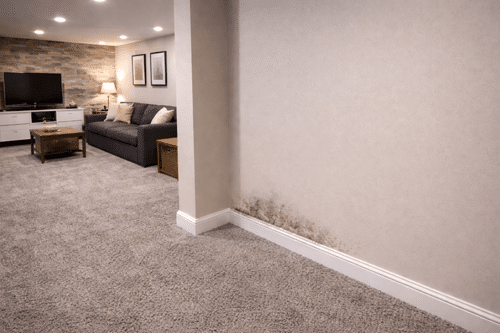
A subtle mold issue near the baseboard in a finished basement, often associated with a musty smell and detected during a professional mold test.
If your basement smells musty, you’re not alone — especially in Michigan, where seasonal humidity and wet weather can turn a small moisture issue into a persistent odor problem. The good news: a musty smell is usually diagnosable in minutes. The bad news: if you only “cover it up,” it often comes back.
This guide gives you a simple checklist to pinpoint the likely cause, stop the smell at the source, and know exactly when it’s time to stop guessing and test for hidden mold.
Schedule a Mold Test / Inspection (Fast answers, no pressure)
Prefer to talk first? Call now: (810) 428-0499
Quick Answer
A musty basement smell usually comes from moisture + organic material (wood, cardboard, carpet padding, dust) that’s staying damp long enough to grow mildew or mold. If the smell returns after cleaning, gets worse after rain, or anyone has allergy-like symptoms, a professional mold inspection/test is often the fastest way to confirm what’s really going on.
The 10-Minute “Musty Basement Smell” Checklist
Do this in order. Don’t overthink it.
1) When do you notice it most?
- Worse after rain: likely seepage, poor grading, foundation cracks, sump/drain issues
- Worse when HVAC runs: possible damp ducts, condensation, or air being pulled from a moldy area
- Worse when you open the basement door: odor “trapped” in basement air
2) Check humidity (this is huge)

Professional mold inspections don’t guess – they measure moisture, find the source, and confirm what’s really in the air.
- If indoor humidity is consistently over ~55–60%, musty smells become much more likely.
- A small hygrometer is cheap and removes guesswork.
3) Look for the “quiet offenders.”
- Cardboard boxes on the floor
- Carpeting/padding
- Stored clothing/paper
- Basement bathrooms with poor ventilation
- Laundry area moisture
4) Follow your nose (seriously)
Smell tends to be strongest near:
- The sump pit/drains
- Under stairs and behind stored items
- Around rim joists/sill plates
- Near water heaters, softeners, and HVAC equipment
5) Look for these visual clues
- Small speckled spotting on wood
- White “powdery” growth on joists
- Water stains on walls or baseboards
- Rust on metal shelving/equipment
- Efflorescence (white crusty mineral deposits on masonry) — often a sign of moisture movement
If you want a definitive answer fast:
Schedule a mold inspection/test, and we’ll identify the likely source and whether mold is present.
Gabby in Swartz Creek, MI thought her musty basement smell was “just humidity” until it started getting worse after every heavy rain.
Turns out, her downspouts were dumping water too close to the foundation, and seasonal condensation  around the rim joist kept humidity high behind storage. Once she fixed drainage, dialed in humidity control, and had the affected areas properly treated, the smell didn’t just improve — it stayed gone.
Read Gabby’s full story (what we found, what was done, and how the mold was handled).
Is It Mold… Or Just a Damp Basement Smell?
Here’s the simple rule:
If you fix the moisture and the smell still comes back, treat it as a “hidden source” problem.
Common scenarios:
- “We run a dehumidifier, but the smell returns” → moisture source may still be feeding growth behind walls, under flooring, or in HVAC zones
- “We cleaned the area and used odor spray” → sprays mask odor; they don’t remove the cause
- “No visible mold anywhere” → hidden mold is common (behind finished walls, under carpet, inside cavities)
When it’s more likely mold:
- Odor is persistent (weeks+)
- Symptoms flare up in the basement (sneezing, headaches, itchy eyes)
- Smell worsens after rain/humidity spikes
- Past flooding, plumbing leaks, or foundation seepage
Local note (Davison):
If your home has a basement that cycles between damp and dry across seasons, the repeated moisture swings can keep feeding odors even when the basement “looks fine.”
What You Can Do Today (Safe DIY Steps That Actually Help)
1) Reduce humidity (target under ~50–55%)
- Run a dehumidifier with a drain hose (so it doesn’t shut off when full)
- Keep basement doors closed if the upstairs air is humid
- Make sure dryer vents outside and isn’t leaking moist air indoors

Utility rooms are a common hotspot for hidden moisture – this quick scan helps catch problems before they become mold.
2) Improve airflow
- Don’t push storage tight against exterior basement walls
- Open up hidden corners and under-stair spaces
3) Remove odor-absorbing “fuel.”
- Replace soggy cardboard storage with plastic bins
- Remove wet carpet/padding (padding can hold odor even after the surface dries)
4) Fix the moisture source (this is the real win)
- Downspouts extended away from the foundation
- Gutters are clear and functioning
- Grading slopes away from the house
- Sump pump functioning + correct discharge location
Quick truth:
If moisture continues, odor returns. Always.
When You Should Stop Guessing and Get a Mold Test / Inspection
Consider testing if any of these are true:
- The musty smell is persistent or returns quickly
- You’ve had water intrusion (even “minor”)
- You’re finishing the basement (don’t seal in a problem)
- Someone in the home has ongoing respiratory symptoms
- You’re buying/selling and want documentation or peace of mind
Want a clear yes/no?
Schedule a Mold Test / Inspection
You’ll get a straightforward assessment and next steps — not a sales pitch.
What a Professional Mold Inspection Does (In Plain English)
A good inspection aims to answer three questions:
- Is mold present? (including hidden mold)
- Where is the moisture coming from?
- What’s the most practical fix so it doesn’t come back?
Depending on the situation, that can include visual evaluation, moisture checks, and targeted testing (air/surface) to confirm what’s in the environment.
The “Musty Smell” FAQ (Featured Snippet Friendly)
Does a musty smell always mean mold?
Not always — but it almost always means moisture + something organic staying damp. Mold or mildew is common, even if it’s hidden.
Will a dehumidifier remove the smell permanently?
A dehumidifier helps a lot, but if there’s an ongoing moisture source (seepage, leaks, condensation), the smell often returns.
Why does it smell worse when the furnace or AC runs?
HVAC can change airflow and pressure, pulling air from damp areas or distributing odors more efficiently.
Can I just use bleach or vinegar?

Surface cleaning can reduce visible growth, but it doesn’t fix moisture or address hidden sources. If the odor returns, it’s a signal to investigate deeper.
What’s the fastest way to confirm if it’s mold?
A targeted inspection/test is often faster (and cheaper) than repeated DIY trial-and-error.
Book a Mold Test / Inspection
Or call: (810) 428-0499
Prefer a quick online request? Contact us here.
- Text: “Get a Mold Test” (989) 971-6980
- “Fast answers. Clear next step.”
What You’ll Get.
- Clear results + practical next steps
- No-pressure approach